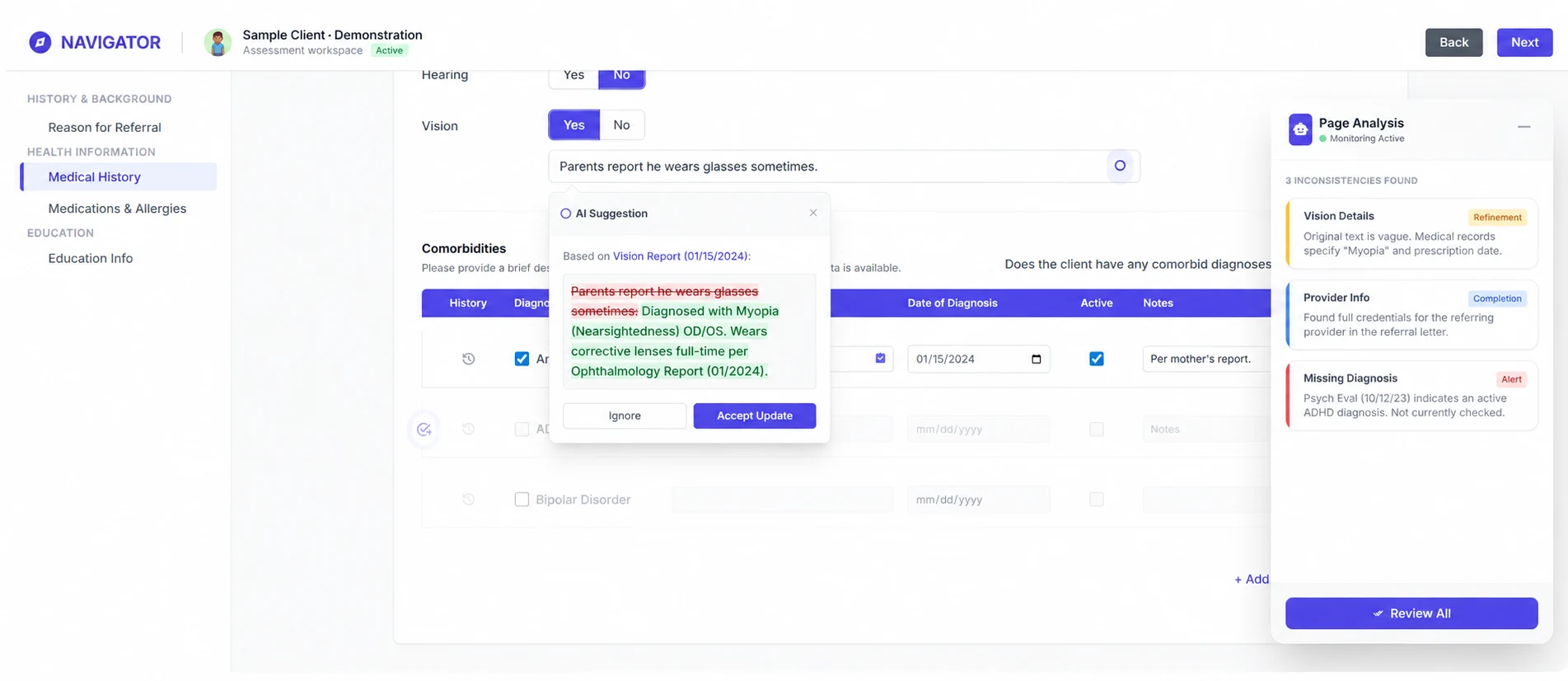
Put intelligence inside the workflow
Clinical teams work across records, transcripts, forms, and documentation requirements. The opportunity for AI extends beyond generating a paragraph. It starts with preparing the right context and ends with a useful result that a clinician can review in the flow of their work.
We build that complete experience: data preparation, grounded drafting, structured checks, and in-application assistance.
Context first. Useful output next.
Source-informed drafting. Clinical information is gathered and prepared before a writing workflow runs. Structured outputs give the next step a consistent starting point, rather than leaving every clinician to assemble the same context manually.
Writer and checker workflows. Dedicated stages separate drafting from evaluation. Structured checks surface review flags and preserve the information teams need to examine an output.
Assistance in existing tools. Browser-based workflows connect relevant records, transcripts, documents, and form context to the task at hand. Teams get support where the work already happens.
Quality as part of the product
Documentation tools combine deterministic checks with AI-assisted content review. Evaluation is built around meaningful examples and the specific task. Clinical review remains an explicit part of the experience, with source context and review flags available to support the final decision.
What this makes possible
- Less time assembling context and preparing a first draft.
- More consistent structure across documentation workflows.
- Clearer review signals and fewer disconnected tools.
- More time and attention available for the work of care.